
Blisters on the Camino: Prevention, Treatment, and Real-World Trail Tips
If there’s one unwelcome companion every pilgrim meets along the Camino de Santiago, it’s the humble blister. No matter how well trained you are, the daily grind of 20–30 kilometre walking stages — heat, dust, moisture, and endless cobblestones — can find a weakness in even the best-prepared feet.
But take heart: every pilgrim learns their own rhythm of prevention, treatment, and recovery along the way. Let’s look at how to protect your feet from the start, and what to do if blisters appear mid-walk.

Why Blisters Happen
Blisters form when friction, heat, or moisture build up between your skin and socks or shoes. On the Camino, it’s often a combination of damp socks, grit, and shoes that subtly rub the same spot with every step. Multiply that by 40,000 steps a day, and you can see why even small irritations can turn into big problems.
Prevention Is Everything
1. Choose and Break In Your Shoes
The best hiking shoes are the ones that already know your feet. Break them in long before you set foot in Saint‑Jean‑Pied‑de‑Port or Roncesvalles. Make sure they allow enough toe room for long downhills, and test them fully loaded as you’ll wear them on the trail.
Your shoes will likely be your most important gear investment — check our Camino Footwear Guide for recommendations and fitting tips.
2. Pick the Right Socks
Many pilgrims swear by toe socks, like Injinji, because they prevent skin-on-skin rubbing between toes. Others prefer double-layer hiking socks (such as Wrightsock) that let the inner layer move with your foot while the outer layer rubs against the shoe.
Whatever your choice, bring at least three pairs and rotate them daily. I personally find injiji toe socks a bit strange, the feeling of a little sock on each toe just feels unusual to me so if you want to use them I suggest you try them first.
3. Keep Feet Dry
If you are having big blister troubles – you can change socks at midday, rinse and dry them at each stop, and avoid walking long distances in damp socks. Foot powder or anti-friction balm (like Body Glide or 2Toms) helps keep moisture at bay — a small ritual that pays off over hundreds of kilometres. I sometimes use Vaseline gel on hotspots on my feet.
4. Pre‑Tape Known Hot Spots
If you know your trouble areas — heels, arches, little toes — tape them before walking. Leukotape, KT tape, or Compeed patches work wonders as preventive barriers. Some pilgrims tape up daily, especially in the early stages. I try to always have an abundance of compeed second skin patches. They really do reduce the pain and friction of a hot spot or blister and you can keep going.
5. Let Your Feet Breathe
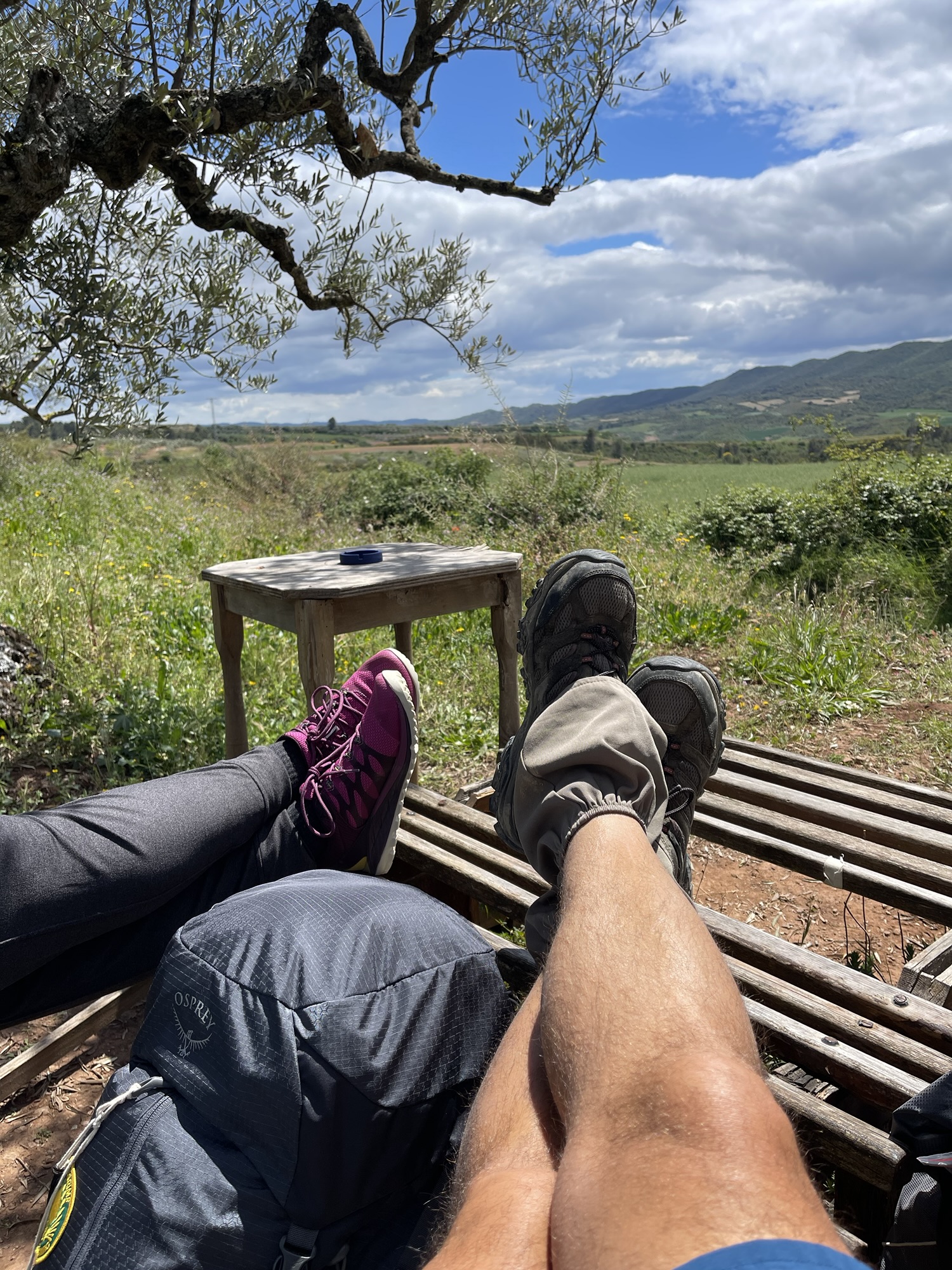
At café or albergue stops, peel off your shoes, air your feet, and rest. A 10-minute “foot siesta” can do more for prevention than any medical kit. If there is running water – a foot soak is really worthwhile. There are several notable places along Camino Frances where a foot soak is the perfect end to a hard day on your feet.
When Blisters Strike
Even with perfect care, most pilgrims earn at least one blister somewhere along the route. The key is dealing with it early — before it forces a rest day.
Step 1: Assess
If it’s small and unopened, cover it with a Compeed blister plaster or medical tape and let it heal naturally. These act as a second skin and prevent further rubbing.
Step 2: Drain (if necessary)
For large, painful blisters, use a sterilised needle to make a tiny puncture at the edge. Drain the fluid gently but leave the skin intact — it protects the tender new layer beneath. Clean with antiseptic and cover with a sterile pad or Compeed.
Step 3: Clean and Re‑Dress Daily
Each evening, clean with antiseptic wipes and let the area dry. Redress with fresh tape or blister patches. A tiny first aid kit containing a needle, alcohol wipes, antiseptic cream, and tape is gold on the Camino.
Step 4: Watch for Infection
If redness, swelling, or pus develops, head straight to the local farmacia. Spanish pharmacists are used to treating pilgrim feet and usually speak enough English to help quickly.

Real-World Tips from Seasoned Pilgrims
- Rub Vaseline or Body Glide between toes before walking.
- Choose lightweight trail runners in summer rather than heavy boots to reduce heat buildup.
- Wash, dry, and moisturise your feet every night — let them recover as you do.
- Don’t burst small blisters if they aren’t painful — they often heal faster left alone.
- If pain forces you to slow down, consider shorter stages or a rest day. The Camino rewards adaptation, not speed.
Build Your “Blister Kit”
Here’s a simple list to pack before leaving home:
- 2 rolls of Leukotape
- Compeed blister plasters (different sizes)
- Small needle + thread (for drainage, sterilise with lighter)
- Antiseptic wipes and cream
- Body Glide or foot powder
- 3 pairs of quality hiking socks (toe or double-layer)
Pack these in an easy-to-reach zip pouch so you can tend to your feet anywhere.
Final Thoughts: Blisters as a Teacher
Almost every pilgrim gets a blister or two — it’s part of the Camino experience. These small setbacks teach patience, humility, and gratitude for simple things: a cool breeze, a shaded bench, the kindness of a fellow walker sharing tape at the side of the road.
Treat each blister not as failure, but as a reminder: your body is adapting, your journey is unfolding, and every step — even the sore ones — brings you closer to Santiago.
Buen Camino, and may your blisters be few and your heart be full.
Leave a Reply